All articles · Guide
These Crypto Trades Worked — While Others Failed in a Choppy Market
By Radiant Team, Radiant research ·
Crypto Market Analysis: Trend vs Choppy Conditions and Where Algorithmic Trading Wins
Crypto markets constantly alternate between clear trending phases and choppy, directionless consolidation. Understanding this divide is essential for long-term success — especially in algorithmic trading.
While trending markets reward momentum capture, choppy conditions punish emotional decisions and overtrading. This is precisely where well-designed algorithmic systems demonstrate their edge.
Current Market Environment (2026)
The crypto market remains in a mixed regime:
- Some assets exhibit strong directional momentum and volatility expansion
- Others remain stuck in sideways ranges with frequent false breakouts
This split creates two very different trading environments:
- High-signal trending markets — ideal for systematic strategies
- Low-signal choppy markets — where discipline and filtering become critical
Trending Markets: Where Algorithmic Trading Excels
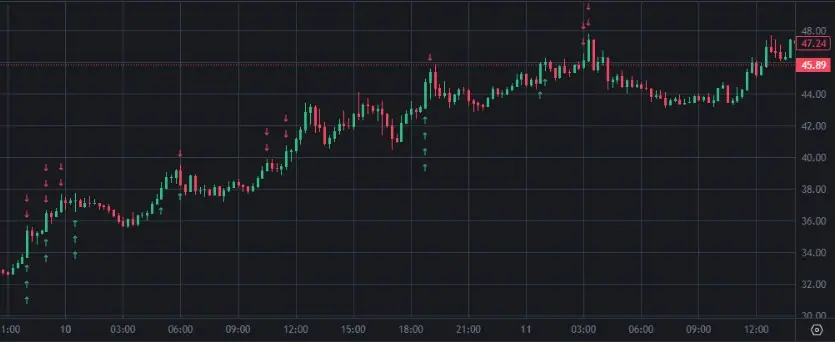
Strong trends provide the cleanest setups for algorithmic execution. Recent examples include:
DASHUSD – Long
Classic trend continuation with sustained upward momentum and increasing volume.
ARCUSD – Long
Breakout after consolidation, followed by volatility expansion — a textbook setup for momentum algorithms.
WLDUSD – Long
Clear momentum acceleration with structured price action.
SWARMUSD – Long
Strong directional move supported by volatility breakout.
In these conditions, trend-following and breakout algorithms perform best because they:
- Enter on confirmed structure
- Scale with momentum
- Use trailing mechanisms to let winners run
Explore current algorithms: 1-minute robots
Choppy Markets: The Silent Killer for Manual Traders
Several assets recently showed classic choppy behavior:
- DOGEUSD
- ZROUSD
- AVAXUSD
- WIFUSD
Characteristics of choppy conditions:
- Sideways price action with no clear direction
- Frequent false breakouts
- Low signal-to-noise ratio
- High emotional pressure
Manual traders often lose money here through overtrading, revenge entries, and premature exits. Algorithmic systems, by contrast, are designed to:
- Filter out low-probability setups
- Reduce trade frequency
- Maintain strict risk limits
- Stay flat when conditions are unfavorable
Trend vs Choppy Markets: Direct Comparison
| Market Condition | Characteristics | Manual Trading Challenge | Algorithmic Trading Advantage |
|---|---|---|---|
| Trending | Clear direction, momentum | Fear of missing out | Consistent execution & position scaling |
| Choppy / Sideways | Noise, false breakouts | Overtrading & emotional entries | Trade filtering & capital preservation |
| Volatility Expansion | Breakouts after consolidation | Late entries | Fast, rule-based reaction |
| Low Volatility | Range-bound action | Boredom → forced trades | Patience & reduced activity |
Why Algorithmic Trading Wins in Mixed Regimes
The biggest challenge in crypto is not strategy selection — it is consistent execution across changing conditions.
Algorithmic systems provide:
- Objective decision-making (no emotion)
- Predefined rules for every market regime
- Automatic risk reduction in unfavorable conditions
- Systematic participation only in high-probability setups
This leads to more stable performance curves and better long-term survival rates.
How Radiant Navigates These Conditions
Radiant is built as an adaptive algorithmic trading infrastructure that automatically adjusts to the current market regime:
- Increases aggression during confirmed trends
- Reduces exposure and trade frequency in choppy conditions
- Applies dynamic risk management across the entire portfolio
- Maintains full transparency with live execution data
This structured approach helps traders stay positioned in trending assets while protecting capital during noisy periods.
Learn how the system works: 1-minute robots
Watch live trading: Live trading
Final Thoughts
Crypto markets will always alternate between trending and choppy phases. The traders who succeed long-term are not those who predict every move, but those who execute consistently with proper structure.
Algorithmic trading — when built with strong risk management — excels exactly because it removes human bias and enforces discipline across all market conditions.
FAQ
What is a choppy market in crypto?
A choppy market is characterized by sideways price movement with no clear trend, frequent false breakouts, and low signal quality.
Why do most traders lose money in sideways markets?
They tend to overtrade, chase false signals, and let emotions drive decisions instead of waiting for high-probability setups.
How does algorithmic trading help in mixed market conditions?
It filters low-quality trades, follows strict rules, reduces activity during chop, and scales exposure only when favorable conditions appear.
Are trend-following strategies better than counter-trend ones?
Trend-following strategies generally perform more consistently in crypto due to frequent strong momentum phases, but combining both in a portfolio is often optimal.
Can algorithmic systems completely avoid losses in choppy markets?
No. Losses are part of trading, but well-designed algorithms minimize them through trade filtering and strict risk controls.
Is algorithmic trading more effective than manual trading overall?
In most cases yes — particularly for consistency and emotional discipline. However, success still depends on strategy quality and risk management.
Ready to trade with structure across all market conditions?
Explore Radiant algorithms: 1-minute robots